May 24, 2010

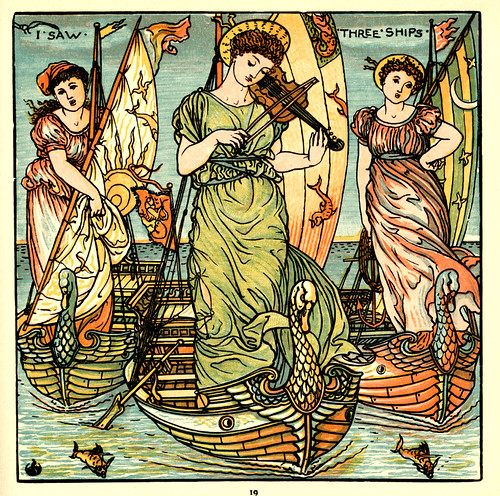
3 Maries of the Sea


I saw 3 ships come sailing...
On [five months after] Christmas day in the morning.
something  (else) to listen to while reading...
On May 24-25, Gypsies (and quite a few gaugo too) throng to Camargne, south of Arles, France at the mouth of the river Rhone, to the church of Saintes Maries de la Mer.  It is a pilgrimage to honour Sara, their patron saint.
"Sara la Kali" they call her, Kali meaning gitane (gypsy) and black, but also, given the gypsies' origin in north India, Sara could be an aspect of the Hindu deity Kali.
There are two legends about Sara.  In one, she is an Egyptian maidservant of Mary Salome and Mary Jacobe, mothers of saints James and John and relatives of Mary Magdalene.  Traveling together, they encountered a storm at sea.  It is Sara who guides them by the stars to the distant shore.
In the other legend, the gypsy queen Sara was camping on shore when the boats approached.  The sea was rough, the boats threatened to founder, so Sara threw her dress on the waves and, using it it as a raft, she floated towards and rescued the 3 Maries.
The Gitane have a tendency to adapt to the religions of whatever lands they travel in.  In the old days, once a year they took a statue of Ishtari (aka Astarte) to the sea and immersed it for benediction.  Nowadays that ritual perseveres in the rites and processions for Sara.
Violins and guitars fill the evening air with music, and together with the swirling dancers, give the night a wild beauty.  As the sky darkens, each pilgrim takes a white candle in hand and enters the church of Saintes Marie de la Mer.  Lighting from a central candle, they add their own flame to the white fiery forest growing in the chapel crypt, illuminating the statue of Sara - Saint Sara to the gypsies (although the Catholic Church never canonized her).
There is an all-night vigil, and early the next morning the newly clothed statue of Sara la Kali is carried in procession to the beach, surrounded by an honour guard of men carrying tridents.      photos     &   virtual tour   (I like to play these videos at the same time as the first  song on this blog, interesting audio overlays) Sara is ritually submerged in the sea in the same manner as Ishtar, Astarte, Aphrodite, Durga, Kali - all the Great Goddesses of fecundity that precede her. 
The rest of the day is spent in happy diversions, various games of skill and horsemanship.
Tarot of the week: 6 of wands: a horse and rider in procession; on this day, they are headed to the sea, the laurel wreath representing Sara.  The card means Victory; dare we hope that downtrodden races such as the gitane will rise victorious? Or just another celebration of "dogs having their day"?
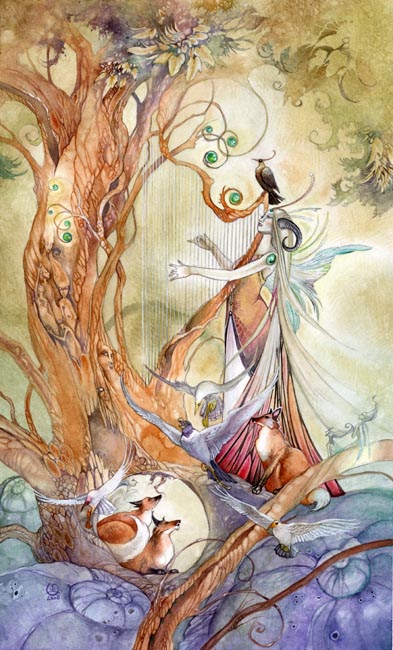
The two cards flanking the Magician in the Beltane reading also remind me of this fete in Provence:  2 of wands looking out to sea for the Mary boats (btw, the name Mary, Marie, etc. literally means sea; the word in French and Italian is mar and mare).  The other card, Page of Cups, is sometimes called the Princess of Palace of the Sea, may be the poet of Stevie Nicks' heart? She is a gypsy troubadour, after all.
~ * ~
Let us remember, friends of Diana, that May 24 is the birth of Artemis (naturally, here are more lynx to  a song , and another ).  China celebrates the mugwort festival on this day, which happens to be one of Her sacred plants, an artemisia.   A Roman festival of Diana as goddess of the Wildwood commences now and today is also a Day of the Horae.  
In my younger days, I would at this time every year go swimming by day and dancing around a bonfire  to drums and flutes under the moon and stars at night.  Forse ancora questo anno?  Oh, the wild gypsy nights are calling....

May 15, 2010

Mercury the Magician


I am the Mercury - light of the morning...

...like some windmill, weave light where it's stormy...
-Jimmie Spheeris, from Isle of View  
 full lyrics      listen (will play the entire song only once)
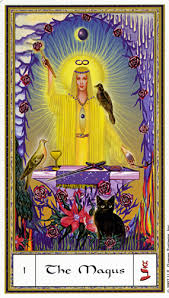
Mercuralia at the Ides of May celebrates the Greco-Roman Hermes-Mercury and his mother Maia, goddess nymph for whom this month is named.  Serendipitously, the central card in this year's Beltane tarot spread is the one most associated with Hermes-Mercury - The Magician.
The Magician stands like a herm stone in a garden of lily white and rose red, holding aloft the Firebrand, conduit between Heaven and Earth. On the table are symbols of the 4 elements air, fire, water and earth, and serve as keys to their mysteries.  The Magician stands in the centre of these 4 realms, poised to unlock their secrets.
This is card #1 in the tarot, thus linked to the Aces of the four suits, and the Magician hirself is the Ace of aces, the 1st born, the Magical Child.
Wendy Rule's album Zero features several songs inspired by the tarot. Written for the Magician, and for her son, "Child the First" brings to mind an image of Maia crooning to her precocious offspring Hermes-Mercury.  Mother's Day only a few days ago, I was happy to spend it with my own (full grown) Magical Child, Philip, and I dedicate the song to him:
I
Child the First
Listen (a snippet)
Now you're here and now you're strong
With mind of sword and power of wand
Each sense a coin to spend along 
the path that you've been set upon
And now you're here with eyes as true
as sun is gold or ocean blue
And all is bright and all is new,
Magician child, in front of you.
     You drip with my blood (it's an offering),
     You slip thru my water, a softening
     of all that's before me and all that's before you,
     Child the First.
And you are    Ability
and you are    Dexterity
You're pure possibility
      and Magic   
      and Alchemy
And you will be changed,
But changing, change Destiny
And you can do anything, anything,
Everything!
Child the First
I
Speaking of Alchemy - 
The royal couple, as Sol and Luna, stand beside a hill representing the "Philosophers' Stone," out of which flow water and fire.  
Mercurius stands uniting the two worlds - represented by two lions with a single stream flowing from its one mouth 
-from Avalon's Red and White Springs by Nicholas R. Mann and Philippa Glasson
I
The red and white springs of Avalon are akin to the roses and lillies in the Magician's garden.  Mercury presides over the alchemical marriage of opposites, and is also born of it as the divine androgyne.
According to the Pythagorean Tarot
The Magician is the creator of a new cosmos [but] to create a new cosmos (order), the old cosmos must be turned upside down. Thus the Magician Hermes is the Lord of Contradiction. First, he is himself a contradictory figure: trickster yet savior, king of misrule yet obedient to justice, deceiving orator yet honest prophet, illusionist yet revealer of truth, fraudulent conjurer yet genuine mage, thief yet honest trader, diabolical yet angelic, material yet spiritual. [He is even identified with both Jesus Christ and Lucifer as the Morning Star (Mercury)]  Second, he governs contradiction, and shows the way that finds unity in opposition. In particular, he governs the transformation of a bad situation into a good outcome. Remember that on the day of his birth Hermes stole Apollo's cattle, tricked him and lied about it ["who,  me? I was only born yesterday"], yet these crimes eventuated in Apollo receiving the lyre [made from a tortoise shell by the infant Hermes] and becoming the patron of the arts, and in Hermes becoming the patron of divination and shepherds. Hermes teaches us that the worst evils can be transformed to good. He provokes us into new insights
Arianna Huffington, author of Gods of Greece, would agree.  Hermes is her favourite Greek God and she even brings him into her political discussions on the Huffington Post, which she co-founded and is editor in chief:
Winged messenger in perpetual motion, as an old man, or a fixed stone, Hermes embodies both action and serendipity, and that which never changes. He is the guide of our voyage and the guardian-spirit of our adventure.
Whenever things seem fixed, rigid, "stuck," Hermes introduces fluidity, motion, new beginnings. He is the primordial divine child -- the child who, if we're lucky, we never outgrow. Hermes' world is a magical world full of signs and significance. He was the god who first gave me, as a child, a sense of the miraculous all around me. His spirit is fluid, trusting, open. Introducing the element of the unexpected into our lives is one of the means he uses to spur us out of our complacency, to break through the inertia and confinement of habit and convention.
Hermes clearly represents a very important key to fearlessness: the freedom of not having to be in control all the time, of not always being the one who has to make things happen. His dual nature also helps us accept life's paradoxes - that the only constant is change. Which is why he is the god of connections, bridging realms and dissolving frontiers...full article here 
Some more Tarot Magicians:
Spiral                                    Renaissance                                   Mythic 
Alchemical
I
Androgynous Mercury the Magician is pictured as female in some decks:
Romani                               Gendron

May 8, 2010

Helston Furry - Robin Hood games

Robin Hood and Little John
They both are gone to Fair-O,
And we shall to the merry Greenwood
To see what they do there-O,
And for to chase - O,
To chase the buck and doe.
With Hal-and-Tow,
Jolly rumble, O.
-"Furry Song" and Morris Dance, Cornwall 
/
The 16th century "Robin Hood games" were popular features in British Mayfests.  One of the oldest surviving spring festival in the world just might be the Furry Dance in Helston, Cornwall on the 8th of May.  The "fur" in Furry doesn't seem to have much to do with animal skins at this warm time of year; perhaps they'd be more appropriately titled "leafy" or "flowery" for the ubiquitous garlands and foliate masks and floral crowns bedecking the people, towns and wells of Merry Old England in springtime.
~ * ~
"Furry" is explained as deriving from Flora, the Roman goddess of blossoms; her Floralia celebration spans late April through early May.  More likely, it comes from the old Cornish word fer, which in turn comes from the Roman feria; both words mean holy day, festival, fair. 
~ * ~
Revelers rise very early on the 8th of May for dawn rituals of gathering green branches and early morning dancing, wearing lillies of the valley.   Then come the processions and plays, i.e. the "games," featuring Helston's patron saint Michael, whose feast day in Helston is today (late September in most places), and St. George, patron saint of England.  The modern Furry Dance has been reduced to a crowded touristy affair, but in the old days a key component was the "Robin Hood games".  The Furry Dance is said to be directly linked to earlier pagan rites celebrating Robin Hood and Herne the Hunter (aka Cernunnos).
~ * ~
Robin Hood is Lord of the Greenwood,
the wild and untamable, yet gentle, archetype of the divine archer, whose aim is always true.  As stag god of the forest, he is considered one and the same as, or alternately the son of, Herne the Hunter.  Certainly Robin Hood is a folk hero, representing freedom and defiance of authority, a champion of the poor and the dispossessed (maybe that's why I like him so much).
~ * ~
Marion, his consort, is Queen of the May, the White Lady of the woodland who could shapeshift into a deer, running away from the confinements of civilization to join her lover in Sherwood Forest.
The legend of Robin Hood is one of my most favourites, second only to the (much more obscure) legends of Elen.  A new theatrical version is coming to the cinema next week, and I can hardly wait.  
Surpassing all Robin Hood films to date is hands down the HTV series Robin of Sherwood , enhanced by Clannad's haunting soundtrack, Legend.  It took a long time, but they are finally available on DVD, and many clips are also featured on youtube:
- Nothing is Forgotten makes music video montages of Clannad's music set to episode clips from the series
- There are several downloaded clips from the series by Ravindraa, but the film quality is poor. The best downloaded clip I could find on youtube is here.  Even that one is a little fuzzy (might be my computer). Happily the DVD sets are available in the library :-)
~ * ~
Like other May Day festivities (May Day in England is celebrated on the 8th and 13th as well as the 1st) the Helston Furry Dance has associations with water.  Anyone caught working on this holiday was taken to the river and ordered to leap across it (and consequently get drenched) or pay a troll fee.  
Or one could just simply stand on a bridge and play Pooh Stix .

Beltane tarot reading: Death reversed - 2 Wands - Magician - Page of Cups - 10 Wands reversed
I'm not going to interpret them now, but the 2 Wands from the Sacred Circle deck (chalk hill figure of the Long Man of Wilmington) sort of reminds me of Little John


May 2, 2010

It's May! and She opens the Ways

For the May Day is the Great Day
Sung along the Old Straight Track
And those who ancient lines that Ley
Will heed this song that calls them back
-Jethro Tull  ~Cup of Wonder~
My matron goddess archetype, Elen, is linked to Beltane and is mistress of travel and earth's ley lines.  Reader, please forgive my self indulgence here.  What follows are gleanings from sites about her and will be of most interest to those who share my names (actually Helen, but I go by h~elen, ~elen~, elen~a, etc) or are interested in her deep connection with the mysteries alluded to in the song "Cup of Wonder".
~
Elen is an elemental spirit who rules over the energies of nature.  She reveals herself in both her solar fire aspect as Helen of Troy and the watery and lunar Elen, traversing moonlit forests and sea, guardian of sailors. As a British Venus, Goddess of Gardens, she is Flower Bride of Beltane.  Welsh and Irish revered Elen as a star goddess.  Alex Langstone in his book St Bega and the Sacred Ring equates Elen to the Irish St Bega, and a star in the constellation Lyra, a beacon of light to those who seek the ancient wisdoms.  In "names for your baby" books the name Helen means "light".
~
~In modern...metaphor we might say Helen represented... the ‘Astral Light’, both as lifeforce and astral energies, as well as the leys and waters which transmitted them... More specifically she was also a symbol of the serpentine path of the more subtle ‘Earth energy’, as it weaved its way across the landscape vitalising the environment...~ source: Dionysian Underground 
~
~As the Green Lady, (as my colleague Chesca Potter and myself named her) she peeps out between the trees in forests and woods... At her Holy wells... she is guardian of the underground pathways that carry the sacred waters. As ‘Elen of the Ways’... she is the guardian of the ancient track ways, the Leys, the kundalini currents in nature, and as the Horned Goddess, she leads us to the first track ways, the migratory tracks of the reindeer~ source Mirror of Isis 
~
As St. Helena, she found the ‘true cross’ on one of her many ‘pilgrimages’, just as the goddess Elen always returned to her ‘sacred tree’ after her many ‘travels’ along the ‘ways’. Europe’s most central ley line the ‘St Michael and Mary’ line passes  out of  Palestine through Rhodes, on through Greece and Italy, on through both St Michael’s Mounts (Brittany & Cornwall) and across Cornwall, with its own St Helen tradition, and Ireland. Here she leads us to the lost Shamanism of the isles of Britain,  across Scandinavia, Russia, Iran, India, Mongolia, China, Siberia, across the Bering Straights into the Americas...
~
The Lady gets around!
~
The Brits call her "(H)elen of the Roads".  When the Romans arrived in Britain, they, under the guidance of the Roman Empress, St. Helena, built their own roads on top of the old straight tracks of the leys that they found there.  Roman roads in Britain are called Sarn (H)elen, and these were remarkably straight on - the "Old Straight Track" indeed.
~
~The Celts associated straight paths with magic and the Otherworld, the paths that fairies took from one mound to another, the straight path of a magical spell, and the spirit flight of the shaman. It is significant that Elen is first beheld in a dream, then goes on to build a network of magical roads across Britain. Some associate these with ley lines, the ancient trackways that are said to join together ancient sites, such as tumuli, burial mounds, hillforts, stone circles and so on. It is possible that Elen is the guardian of these, or perhaps she is the guardian of the paths of dreams and visions... Some say that the tracks we call ley lines are spirit paths... Certainly, many people have experienced strange things on the Sarn Elen...~ source Anne Franklin 
~
The Welsh Saint day of Elen of the Hosts is May 22nd, connecting her to Spring, around the time of Beltane. Saint Helena's (Romano-British) feast day is August 18.  A wise woman told me that the actual feast day of Elena is May 2 (Happy Birthday, Gigi! ;) and I too was born on the 2nd day of another month, but so many on my mom's side of the family were born or died on the 22nd day, incl. her (b.Aug 22, d. Dec 22) My mom's name was also Helen, my grandmothers' too.  I'm the latest in a long lineage of Helens.  This used to distress me (who wants to be a Jr.?) but now of course I'm honoured to share Her name:-)
~
~During ancient times, the Dragon power that flowed through the leys was thought to build up in the Spring, and wane in the Fall, which led to the festival or harvest days of the Celts. These rites, representing fertility, were observed at Beltane, or the beginning of Summer, and again at the ending of fall or Samhain, at which a ritual involved killing the Dragon...~  source Bella Online 
~
With the advent of Beltane, around the 1st of May, the spirit of the trackways opens the season of travel.  Whether your paths be physical, mental, spiritual or astral, may She light your way.

Tarot of the Week: Queen of Wands 
Elen in her fiery solar aspect!
Vala tarot (dragon leys at her feet)       Rider tarot empress of solar fire
I know a woman who embodies the Queen of Wands (Leo fire sign) and Elen as well has similarities to her own matron deity, Diana; also she evokes Elen as she goes on her frequent hikes and journeys, backpacking through Europe.  Shaundell is someone I admire, feel a kinship with, and is an inspiring influence in my life. 
Some descriptions of the Queen of Wands:
...a lady with an independent and passionate nature... freedom-loving, lively, often creatively gifted... powerful force for good... prefers the countryside to the town and appreciates the diversity of nature (Jonathan Dee's interpretation of the Italian Tarots) 
...sunny disposition, accomplished, graceful and gracious, as fresh as a spring morning... patroness or adept of the fine arts and sciences... (Renaissance Tarot) 
...honourable... exuberant about everything she does... passionate about things she believes in... temperamental behaviour infuriates even those closest to her... quirky, free spirit... staunch loyal friend... waterfire, heart and soul (notes jotted down from mixed sources)
...generous spirit, burning passions and intense desires... Behaves spontaneously and has a temper.... inspires others... Love of happiness (Mary Greer)
Mary Greer's Tarot for Yourself features a poem about her- Sense and Sensuality: The Queen of Wands 
Animal Tarot by Paula Gibby


At Gigi's birthday party on Walpurgis night, Laurie showed us her fanciful new tarot deck where all the wands are volpe - foxes, vixens.  Here's the Queen of Wands:
Beltane Blessings of good cheer to you - yes, I do mean You!

April 20, 2010

Earth Day, b.c., part 2

The tarot card  of part 1 suits even better the Feria Palila on 21 April, a Roman feast for the sylvan and pastoral goddess Pales (Pales may be several gods, goddesses or nature spirits).  This ancient festival is considered the most direct antecedent to Earth Day.   For the ritual offering, 

...let a basket of millet accompany cakes of millet
The rural goddess particularly delights in food such as that
And viands and pails of milk, such as she loves...
face east, asperge your hands and pray:
"If the nymphs and half goat god
have been put to flight at the sight of me,
If my pruning knife has robbed a holy copse of shady bough...
Appease for us the springs and their divinities,
The deities dispersed through every grove appease..."
--Ovid, Fasti IV, also attributed to Virgil
Pales is (are) guardian(s) of cattle and sheep; at twilight, shepherds purified their sheep and cattle were driven between bonfires to smoke out insects lurking in their coats.  After leaping the bonfire themselves three times, herdsmen would enjoy a feast, with wine and merriment for all.
Warm soya - milk mixed with wine - is today's libation.  Honey is added too, in blessing that the region be the proverbial "land of milk and honey".  Mixing milk with mead would probably work the same.
The foundation of Rome is associated with the Palilia (aka Parilia), commemorating the day Romulus built his city.  After the 2nd century, Parilia celebrated the birthday of Dea Roma (Goddess of Rome). 
^^
All of Europe joins in on the open country revelry that is St. George's Day (April 23), a Christian equivalent of the Parilia. Patron saint of England, soldiers and the Boy Scouts, St. George has associations with Mars (in both his military and georgic aspect, the name George means "farmer") and with the Green Man of Beltane.
When I was a young girl, my neighbor, a retired farmer, used to call everybody, male and female, "George".  And of course I must mention that April 23 is both the birthday and the name day of my lovely lynx-y Maine coon cat - Buon Onomastico, Giorgio! 
^^
This is a Grande Feria throughout Europe.  My ancestors in the Bohemian lands would choose a boy to represent the "tree spirit," who, bedecked with birch and willow, traversed the cornfields on this day.  In the evening, "Green George" is a leafy clad puppet thrown into a running stream (here you go, Pinocchio!) St. George: Christian Dragon Slayer or Pagan Green Man? 
^^
The 23rd day of Aprilis in Rome is the Feria Vinalia, a wine festival (vinum means wine) for Venus and Jupiter.  Before Venus was domesticated as goddess of vinyards and gardens, this feria featured  the Heterae, the dancing girls, professionals who often worked in troupes.  They provided music and dancing during dinners...and were well compensated for their skillful services. 
Shakespeare was born on April 23, and is it any coincidence that April 22, Earth Day, is also the birthday of  St. Francis of Assisi.  From ancient days, April 22 marked a festival of Ishtar, aka Inanna, Asherah, Ashtoreth, middle eastern earth mother goddesses of sexual fecundity.

Sun in earth sign Taurus marks the season of spring fullness; the soil is rich now and prime for planting.  It is said that Taurus gives form to Aries potential.
Taurus the Bull is linked to La Festa di Santo Marco on April 24-25.  There is a legend that a wild bull becomes very mild and obedient when called "Marco".  Such bull is adorned with floral garlands, bread loaves trussed on the horns, and then paraded and fawned upon through the streets.  Reminds me of Spencer's Faerie Queen poem, where "April rides in on a bull". (pictured above)
^^
St. Mark whose holy day is April 24/25  is patron of Venice and is feasted with rise bise, risotto with new spring peas.  In Genzano, near Nemi, (two of the hill towns just outside of Rome) his church is situated on a previous site of worship to Venus.   When I was in Genzano, there was a street festival going on.  We walked up the hill to the church, and there I received a gift and found some lovely mosaic on terra cotta tiles.
From the "Our Lady of Good Counsel" chapter in Our Lady of the Lost and Found by Diane Schoemperlen:
...in the tiny village of Genazzano, Italy, situated on a hilltop thirty miles southeast of Rome....this church...in pagan times, the site of a temple dedicated to Venus, the Roman goddess of love. When early Christians denounced her as a harlot, the temple was razed...Ironically enough, Venus eventually became a Christian saint called Venerina or Venere...It was Venus who was first known as Stella Maris, Star of the Sea.  But now...the title belongs to Mary...
On April 25...with or without a thought to Venus, the citizens of Genazzano are honoring St Mark...
more info here.  Scroll down to "The miraculous picture arrives in Genazzano" (there's even a reference to Our Lady's servant Giorgio ;)
^^
I have a slightly different interpretation of "A lesson for our times" than the average Catholic; to me, the "Reign of Mary"  means a Return of the Goddess - i.e. Nature, the supreme being of Pantheism , and her children - all of us - all species (and Fatima was once a shrine to the Goddess).
^^
Call me crazy if you must, but I credit the miracle.  I know from experience that in Genzano and Nemi extraordinary things occur!

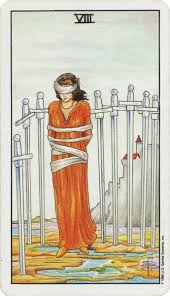
Last week I drew the 8 Swords; looking at it I hear the Police sing "...and when their eloquence escapes me, their logic ties me up and..."
It's all too easy to get wrapped up in damned - if - I - do - damned - if - I - don't situations.  It's push me pull you and someone gets hurt either way.  Do you ever feel like a caged lion?  Each sword is an obstacle to freedom.  An obstacle made up entirely of words and thoughts and gossip and lies and truth and indecision.  Since I also got this card last winter, it shows I have yet to determine how and why I'm imprisoning myself, which swords are impediments and which are my allies, who to believe and who to trust. 
But not you "Valdemort"  so don't waste your breath.   Even if some of what you say is true.  This card used to come up for me when I knew you before and now you're back and it's coming up again.  To quote Mary Oliver in her Sweet Grass  poem, 
I mean the ones that thought to rule my heart. 


I cast them out; I put them on the mush pile. 
They will be nourishment somehow 
(everything is nourishment somehow or another).
No longer mentioned.  No longer even thought about.  Mulch in peace.

^^
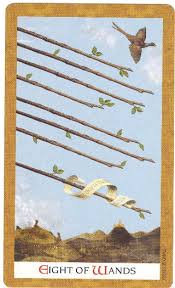
Open to messages of good council, we can break free of these bonds.  Let's keep the 8 but return to the Wands.
Let's bind the polluters and free the earth -
Happy Earth Day! 

Universal Waite 8 Swords & Golden Tarot 8 Wands