August 13, 2010

Feria Nemoralia

The August Ides approaches and I'm feeling wistful.  The streghe who encouraged me to write this article a few years back are deceased or living many miles away, and although I've met others since then, their ways never gelled quite the same, never felt quite so authentic to me. After much soul searching, I've decided that this path is not for me now.  It's not one I'd recommend to eclectics.
Nevertheless I want to include this article, written 7 years ago, in my blog.  It harkens to things I want to keep fresh in my memories...

 The Ides of August is one of the most hallowed times of the year for both Roman Catholics and Italian Pagans. It's the time of the ancient Feria Nemoralia (aka Festival of Torches), later adopted by Catholics to be The Feast of the Assumption. (1) In Italy, this Feria is celebrated either on the 13-15th of August or during the August Full Moon.  In 2011, the solar and lunar Ides will coincide... 
This poem by Ovid, from his Fasti, describes the ancient celebration:  
                              
In the Arrician valley,
there is a lake surrounded by shady forests,
Held sacred by a religion from the olden times...
On a long fence hang many pieces of woven thread,
and many tablets are placed there
as grateful gifts to the Goddess.
Often does a woman whose prayers Diana answered,
With a wreath of flowers crowning her head,
Walk from Rome carrying a burning torch...
There a stream flows down gurgling from its rocky bed...

)0(
Picture this. It is the August Full Moon. A long procession of twinkling lights wind down what is now called Via Diana, or, Diana's Road. The pilgrims forming this procession of torches and candles line up alongside the dark waters of Diana's Mirror, or Lake Nemi. (2) One of the Earth's most sacred sites, the lake is just a few miles south of Rome, Italy, and is dedicated to Diana, the Great Goddess of the Moon. The lake, in a volcanic crater, is almost perfectly oval, and from the vantage point where the Temple of Diana once graced its banks, you can see the Moon reflected clearly in the smooth as glass, dark mirror of water.
The Full Moon shines high in the night. Hundreds have come to Diana's lake, wearing flowers wreathed around their necks and foreheads. According to Plutarch, everyone there had made a special ritual of washing their hair before dressing it with flowers. Garlanded hounds also marched by the side of hunters. Little boats, lit by oil lamps strung on prow and stern, ferried festive crowds back and forth across the lake, traveling from the south jetty to Diana's temple on the north bank. La Luna, rising high overhead, gazed down on the pilgrims and on Her reflection in the lake.

Those gathered there would write small messages on ribbons and tie them to a fence at the sanctuary, in supplication to She Who Provides. Likewise, numerous small statuettes of body parts would have been found there. It was common practice in Italy (and Greece) to bake a small model of an afflicted part of the body and offer it to a God or Goddess as a votive. Also offered were small clay images of mother and child, and tiny sculptures of stags, one of the favored animals of Artemis/Diana. Apples were likewise given to Diana as the Soul of Nature who protects all species, including humans.
Offerings of garlic are made to the Goddess of the Dark Moon, Hecate, during the festival. In Wicca, Diana is often considered the Maiden aspect of the Moon Goddess, Who manifests as Maid, Mother, and Crone. But at the festival of the Nemoralia, Diana is the Mother, and Hecate is the Crone.
)
So who is the Maiden? 
Diana has a legendary daughter, Aradia, whose birthday is given as August 13, 1313. Aradia, so the story goes, was sent to Earth by Her divine Mother to empower the weak and oppressed, particularly the Pagans and gypsies who were chained in slavery to church and state. She was a sort of female "Robin Hood" of the Alban Hills of Italy.  Aradia's Mother, the Goddess Diana, like Robin Hood's Father, Herne (Cernunnos), blessed the oppressed and down-trodden, the peasant, the heathen, all those noble souls and noble "savages" who society despises. Diana's most notable temple in Rome was situated on the most apparently humble of Rome's Seven Hills, the Aventine. The ritual hairwashing that precedes the trek to Nemi also preceeded a procession that ended up at the Aventine.

It seems Diana had fewer  temples built to Her than any other of the main Deities in the Classical pantheon, which no doubt suits Her, since certainly a Goddess of Nature prefers to be worshipped in Her natural groves. And so we go to a wild and natural area and choose a tree to decorate. Traditionally this would have been an evergreen, and on its branches are placed symbols such as silver moons, bows and arrows, tiny animals, as well as ribbons, bells, and other choice items. If you are suffering from any kind of illness, you can make a symbol of that too, and hang it on the branches in supplication for healing. Imagine Her arrows piercing your pain, discomfort, or disability with a powerful potion of wellness.

The Festival of Torches evolved to become one of those sacred times when the hunting or killing of any beast was forbidden all over Italy. It was a Time of Blessing that extended a truce between humankind and the natural world. Likewise, slaves and women were free from their duties during this feria. Men and masters did participate in the festival, but they  were required to be on equal terms with women and slaves. One Roman poet, Propertius, apparently did not attend the festival in the 1st century CE, as indicated in these words to his beloved:

Ah, if you would only walk here in your leisure hours. 
But we cannot meet today,
When I see you hurrying in excitement with a burning torch
To the grove of Nemi where you
Bear light in honour of the Goddess Diana.

At night the lights of hundreds of torches reflected upon Diana's lake and sparkled magically upon the surface. Lamps not unlike these torches were used by Vestal virgins and have been found with images of the Goddess at Nemi, hence Diana and Vesta are sometimes considered one and the same Goddess.

)0(
The nymph Egeria, who resides in a waterfall spilling into Lake Nemi, is also an aspect of Diana. She is intimately connected with Numa, who was the king of Rome after Romulus, and whose kingship's well being was dependent on his relationship with Her, Diana Egeria, Lady of the Lake. Louis Spence, in the 13th century tale, Sir Lancelot of the Lake, tells us that the Lady of the Lake dwells in the Lake of Diana.  Egeria is thus one and the same as Diana, who is also the Lady of the Lake, and is Merlin's lady Nimue (a name similar to, and which may be derived from, "Nemi").

There are also parallels to Shakespeare's Midsummer Night's Dream: Titania, Regina elle Fate (Queen of the Fairies), is equated with Diana, Regina delle Streghe (Queen of the Witches). Hippolytus, who died and was resurrected and spirited to Nemi by Diana (as Virbius, the first Rex Nemorensis), was the son of Theseus (some say Oberon) and Hippolyta. And Puck, the goat like prankster, has his own festival in Britain at this same time of the year, the Puck's Fair. Thus the Midsummer Night's Dream continues on through August.


(1) All of Italy seems to agree that this is the best time of year to take a holiday. Travel agents warn against going to Italy in mid-August; almost the whole country shuts down business for the hallowed Feast of the Assumption. This feast day of Mary, Mother of God, seems to the Italian Catholics to be an even more important holy day than Christmas. This link for more about Our Lady of the Assumption.
(2) Nemi is from the Latin nemus, meaning sacred wood, sacred grove.  A travel journal entry of Lake Nemi, site of the Nemoralia, where I was in September 2001.

July 3, 2010

Corn, Koshares, Kachinas & Cavalla

Corn dancers, Kachinas bring rain,
Corn dancers, Kachinas bring rain...
Robert Mirabal, Hope, from Music from a Painted Cave (PBS)

Almost every pueblo in New Mexico holds a Corn Dance in the summer, and as a result of the influence of Spanish missionaries, it is usually held on the feast day of the village's patron saint (a list of dances for 2010 is here.)
Why a dance? Why not call it a "ritual," a "service" or "Mass"?  To Pueblos and other American Indians, rhythmic movement and music are essential components to their religious observances.  Weeks of preparation and private ritual always culminate in the grand public event, The Dance.
Dances have  many variations, reflecting the differences among the many Pueblo groups themselves, but usually involving lines of dancers moving in a constantly changing zigzag pattern, making gestures that are prayer offerings to the Corn Mother: they lower their arms for the lowering clouds, move their arms in a zig-zag motion for lightning, lower their palms for rain, and lift their hands for the growing stalks of corn. Both sexes participate, the women wearing headdresses called tablitas, thin wooden boards cut in terraced cloud patterns and pierced or painted with the sun, the moon and the stars.  Their hair, usually bound in a squash blossom hairdo or braided, hangs loose in imitation of long wisps of summer rain that sweeps the land.  Tablitas symbolize the special connection that women have with the Corn Mother.
Corn Mother, also called Corn Woman and Corn Maiden, is perhaps the most important deity in Pueblo mythology.  Life began with a Corn Mother, who planted all the flora and fauna in the universe.  Newborn children are given a perfect ear of corn, their own personal Corn Mother, which they keep for life, the dried kernels a continual reminder of this connection of heritage.
In the Pueblo Corn Dance, Koshares, "Delight Makers," impudent holy clowns, pantomime the dancers with exaggerated gestures.  Between dances, they indulge in ribald horseplay, much to the delight of spectators and the chagrin of their "victims".  Koshares have a more practical function as well, performing services like making needed adjustments and repairs to the dancers clothing.  They are representatives of spirits of the departed who possess much power to bring rain clouds and influence the growth of crops.
Koshares are not to be confused with Kachinas, however. Kachinas are not gods (as commonly supposed) but symbolic representations in humanlike form, of the spirits of nature and the ancestors.  There are over 300 different Kachinas and, although Hopi and Zuni of the western Pueblo tribes have the most, they are a part of the ceremonials of all Pueblo people.
Children are given carved cottonwood dolls that look like Kachinas to play with, so that they would not be frightened when they saw men in the tribe dress like the Kachinas during ceremonies.  Once a boy turns 13, he is invited to the kiva where the identity of the Kachinas is revealed to him.  Girls are not brought to the kiva, but they are also told the secret of the Kachinas.
_[ ]_
It was a bit difficult to decide whether to attend the St John feast day dances at the namesake San Juan pueblo or Taos, but I'm glad we chose Taos, because it happened to be the same day that Robert Mirabal gave a free concert at the Taos plaza!  It was a huge crowd gathered, and my husband Bob hung out toward the back, but I was up there dancing with a few brave souls right next to the stage.  Mirabal asked himself aloud if he was in the company of Catholics celebrating the feast of San Juan, but concluded that we were all a bunch of Pagans!  Doubtful, but no one objected, everybody was spellbound by the music.
The next day, we got back on Hwy 68 to go white water rafting on the Rio Grande, and afterward on our way back to Albuquerque, we got out of the car to take some scenic pictures.  I turned around to find I was being followed by an old but very beautiful white mare, her mane shining bright in the evening sun.  Bob said it was my Spirit Horse, but she actually belonged with the niece of a Taos pueblo shopkeeper.
"Spirit Horse"
Get this poster by Robert Medina Cook and help support horse rescue non profit organizations.


June 13, 2010

Epona

Today is the feast day of the Romano British equestrian goddess Epona.
 (music: Epona by Enya) 
Her Roman feria is in December, and I'm not sure when the Celts first assigned this day to her, but now is appropriate; Horse Fairs flourished June-September throughout Britain and Ireland since at least the pre-Victorian era.  The most famous of these, the Appleby Fair in Cumbria, is always in June.
^^
I've been dreaming of white horses lately, and they've been popping up in tarot readings. In the 6 Wands a mild and noble white horse carries the hero high above the mundane crowd like a water lily lifted above the murky water.  
This week's featured tarot card, XIX The Sun, shows another beautiful white horse carrying the radiant child forward into a new a happy destination. The horse frees the rider from any constraint, enabling travel and exploration. 
In shamanism, the horse is a psychopomp, the drumming hoofbeats leading the astral traveler in journeys through the Otherworld.
^^
Some keywords for horse symbolism are beauty, chivalry, cooperation, dignity, endurance, freedom, friendship, grace, journey, loyalty, movement, nobility, power, service, speed, stamina, strength, travel, wildness, all of which well apply to my son, Philip, whose name itself means lover of horses.  Also when he took my favourite personality test, Animal in You, he got the result of Horse.
The tarot Sun card also represents him to me, since he is my only son, and one of the brightest stars in my sky. 

May 24, 2010

3 Maries of the Sea


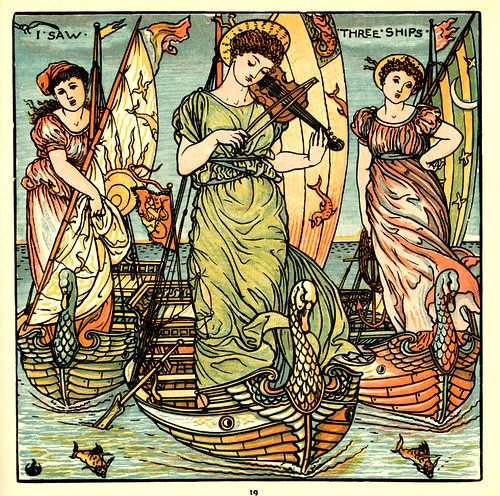
I saw 3 ships come sailing...
On [five months after] Christmas day in the morning.
something  (else) to listen to while reading...
On May 24-25, Gypsies (and quite a few gaugo too) throng to Camargne, south of Arles, France at the mouth of the river Rhone, to the church of Saintes Maries de la Mer.  It is a pilgrimage to honour Sara, their patron saint.
"Sara la Kali" they call her, Kali meaning gitane (gypsy) and black, but also, given the gypsies' origin in north India, Sara could be an aspect of the Hindu deity Kali.
There are two legends about Sara.  In one, she is an Egyptian maidservant of Mary Salome and Mary Jacobe, mothers of saints James and John and relatives of Mary Magdalene.  Traveling together, they encountered a storm at sea.  It is Sara who guides them by the stars to the distant shore.
In the other legend, the gypsy queen Sara was camping on shore when the boats approached.  The sea was rough, the boats threatened to founder, so Sara threw her dress on the waves and, using it it as a raft, she floated towards and rescued the 3 Maries.
The Gitane have a tendency to adapt to the religions of whatever lands they travel in.  In the old days, once a year they took a statue of Ishtari (aka Astarte) to the sea and immersed it for benediction.  Nowadays that ritual perseveres in the rites and processions for Sara.
Violins and guitars fill the evening air with music, and together with the swirling dancers, give the night a wild beauty.  As the sky darkens, each pilgrim takes a white candle in hand and enters the church of Saintes Marie de la Mer.  Lighting from a central candle, they add their own flame to the white fiery forest growing in the chapel crypt, illuminating the statue of Sara - Saint Sara to the gypsies (although the Catholic Church never canonized her).
There is an all-night vigil, and early the next morning the newly clothed statue of Sara la Kali is carried in procession to the beach, surrounded by an honour guard of men carrying tridents.      photos     &   virtual tour   (I like to play these videos at the same time as the first  song on this blog, interesting audio overlays) Sara is ritually submerged in the sea in the same manner as Ishtar, Astarte, Aphrodite, Durga, Kali - all the Great Goddesses of fecundity that precede her. 
The rest of the day is spent in happy diversions, various games of skill and horsemanship.
Tarot of the week: 6 of wands: a horse and rider in procession; on this day, they are headed to the sea, the laurel wreath representing Sara.  The card means Victory; dare we hope that downtrodden races such as the gitane will rise victorious? Or just another celebration of "dogs having their day"?
The two cards flanking the Magician in the Beltane reading also remind me of this fete in Provence:  2 of wands looking out to sea for the Mary boats (btw, the name Mary, Marie, etc. literally means sea; the word in French and Italian is mar and mare).  The other card, Page of Cups, is sometimes called the Princess of Palace of the Sea, may be the poet of Stevie Nicks' heart? She is a gypsy troubadour, after all.
~ * ~
Let us remember, friends of Diana, that May 24 is the birth of Artemis (naturally, here are more lynx to  a song , and another ).  China celebrates the mugwort festival on this day, which happens to be one of Her sacred plants, an artemisia.   A Roman festival of Diana as goddess of the Wildwood commences now and today is also a Day of the Horae.  
In my younger days, I would at this time every year go swimming by day and dancing around a bonfire  to drums and flutes under the moon and stars at night.  Forse ancora questo anno?  Oh, the wild gypsy nights are calling....

May 15, 2010

Mercury the Magician


I am the Mercury - light of the morning...

...like some windmill, weave light where it's stormy...
-Jimmie Spheeris, from Isle of View  
 full lyrics      listen (will play the entire song only once)
Mercuralia at the Ides of May celebrates the Greco-Roman Hermes-Mercury and his mother Maia, goddess nymph for whom this month is named.  Serendipitously, the central card in this year's Beltane tarot spread is the one most associated with Hermes-Mercury - The Magician.
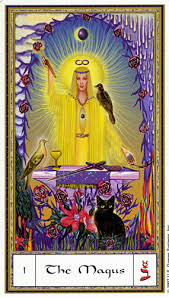
The Magician stands like a herm stone in a garden of lily white and rose red, holding aloft the Firebrand, conduit between Heaven and Earth. On the table are symbols of the 4 elements air, fire, water and earth, and serve as keys to their mysteries.  The Magician stands in the centre of these 4 realms, poised to unlock their secrets.
This is card #1 in the tarot, thus linked to the Aces of the four suits, and the Magician hirself is the Ace of aces, the 1st born, the Magical Child.
Wendy Rule's album Zero features several songs inspired by the tarot. Written for the Magician, and for her son, "Child the First" brings to mind an image of Maia crooning to her precocious offspring Hermes-Mercury.  Mother's Day only a few days ago, I was happy to spend it with my own (full grown) Magical Child, Philip, and I dedicate the song to him:
I
Child the First
Listen (a snippet)
Now you're here and now you're strong
With mind of sword and power of wand
Each sense a coin to spend along 
the path that you've been set upon
And now you're here with eyes as true
as sun is gold or ocean blue
And all is bright and all is new,
Magician child, in front of you.
     You drip with my blood (it's an offering),
     You slip thru my water, a softening
     of all that's before me and all that's before you,
     Child the First.
And you are    Ability
and you are    Dexterity
You're pure possibility
      and Magic   
      and Alchemy
And you will be changed,
But changing, change Destiny
And you can do anything, anything,
Everything!
Child the First
I
Speaking of Alchemy - 
The royal couple, as Sol and Luna, stand beside a hill representing the "Philosophers' Stone," out of which flow water and fire.  
Mercurius stands uniting the two worlds - represented by two lions with a single stream flowing from its one mouth 
-from Avalon's Red and White Springs by Nicholas R. Mann and Philippa Glasson
I
The red and white springs of Avalon are akin to the roses and lillies in the Magician's garden.  Mercury presides over the alchemical marriage of opposites, and is also born of it as the divine androgyne.
According to the Pythagorean Tarot
The Magician is the creator of a new cosmos [but] to create a new cosmos (order), the old cosmos must be turned upside down. Thus the Magician Hermes is the Lord of Contradiction. First, he is himself a contradictory figure: trickster yet savior, king of misrule yet obedient to justice, deceiving orator yet honest prophet, illusionist yet revealer of truth, fraudulent conjurer yet genuine mage, thief yet honest trader, diabolical yet angelic, material yet spiritual. [He is even identified with both Jesus Christ and Lucifer as the Morning Star (Mercury)]  Second, he governs contradiction, and shows the way that finds unity in opposition. In particular, he governs the transformation of a bad situation into a good outcome. Remember that on the day of his birth Hermes stole Apollo's cattle, tricked him and lied about it ["who,  me? I was only born yesterday"], yet these crimes eventuated in Apollo receiving the lyre [made from a tortoise shell by the infant Hermes] and becoming the patron of the arts, and in Hermes becoming the patron of divination and shepherds. Hermes teaches us that the worst evils can be transformed to good. He provokes us into new insights. 
Arianna Huffington, author of Gods of Greece, would agree.  Hermes is her favourite Greek God and she even brings him into her political discussions on the Huffington Post, which she co-founded and is editor in chief:
Winged messenger in perpetual motion, as an old man, or a fixed stone, Hermes embodies both action and serendipity, and that which never changes. He is the guide of our voyage and the guardian-spirit of our adventure.
Whenever things seem fixed, rigid, "stuck," Hermes introduces fluidity, motion, new beginnings. He is the primordial divine child -- the child who, if we're lucky, we never outgrow. Hermes' world is a magical world full of signs and significance. He was the god who first gave me, as a child, a sense of the miraculous all around me. His spirit is fluid, trusting, open. Introducing the element of the unexpected into our lives is one of the means he uses to spur us out of our complacency, to break through the inertia and confinement of habit and convention.
Hermes clearly represents a very important key to fearlessness: the freedom of not having to be in control all the time, of not always being the one who has to make things happen. His dual nature also helps us accept life's paradoxes - that the only constant is change. Which is why he is the god of connections, bridging realms and dissolving frontiers...full article here 
Some more Tarot Magicians:
Spiral                                    Renaissance                                   Mythic 
Alchemical
I
Androgynous Mercury the Magician is pictured as female in some decks:
Romani                               Gendron

May 8, 2010

Helston Furry - Robin Hood games

Robin Hood and Little John
They both are gone to Fair-O,
And we shall to the merry Greenwood
To see what they do there-O,
And for to chase - O,
To chase the buck and doe.
With Hal-and-Tow,
Jolly rumble, O.
-"Furry Song" and Morris Dance, Cornwall 
/
The 16th century "Robin Hood games" were popular features in British Mayfests.  One of the oldest surviving spring festival in the world just might be the Furry Dance in Helston, Cornwall on the 8th of May.  The "fur" in Furry doesn't seem to have much to do with animal skins at this warm time of year; perhaps they'd be more appropriately titled "leafy" or "flowery" for the ubiquitous garlands and foliate masks and floral crowns bedecking the people, towns and wells of Merry Old England in springtime.
~ * ~
"Furry" is explained as deriving from Flora, the Roman goddess of blossoms; her Floralia celebration spans late April through early May.  More likely, it comes from the old Cornish word fer, which in turn comes from the Roman feria; both words mean holy day, festival, fair. 
~ * ~
Revelers rise very early on the 8th of May for dawn rituals of gathering green branches and early morning dancing, wearing lillies of the valley.   Then come the processions and plays, i.e. the "games," featuring Helston's patron saint Michael, whose feast day in Helston is today (late September in most places), and St. George, patron saint of England.  The modern Furry Dance has been reduced to a crowded touristy affair, but in the old days a key component was the "Robin Hood games".  The Furry Dance is said to be directly linked to earlier pagan rites celebrating Robin Hood and Herne the Hunter (aka Cernunnos).
~ * ~
Robin Hood is Lord of the Greenwood,
the wild and untamable, yet gentle, archetype of the divine archer, whose aim is always true.  As stag god of the forest, he is considered one and the same as, or alternately the son of, Herne the Hunter.  Certainly Robin Hood is a folk hero, representing freedom and defiance of authority, a champion of the poor and the dispossessed (maybe that's why I like him so much).
~ * ~
Marion, his consort, is Queen of the May, the White Lady of the woodland who could shapeshift into a deer, running away from the confinements of civilization to join her lover in Sherwood Forest.
The legend of Robin Hood is one of my most favourites, second only to the (much more obscure) legends of Elen.  A new theatrical version is coming to the cinema next week, and I can hardly wait.  
Surpassing all Robin Hood films to date is hands down the HTV series Robin of Sherwood , enhanced by Clannad's haunting soundtrack, Legend.  It took a long time, but they are finally available on DVD, and many clips are also featured on youtube:
- Nothing is Forgotten makes music video montages of Clannad's music set to episode clips from the series
- There are several downloaded clips from the series by Ravindraa, but the film quality is poor. The best downloaded clip I could find on youtube is here.  Even that one is a little fuzzy (might be my computer). Happily the DVD sets are available in the library :-)
~ * ~
Like other May Day festivities (May Day in England is celebrated on the 8th and 13th as well as the 1st) the Helston Furry Dance has associations with water.  Anyone caught working on this holiday was taken to the river and ordered to leap across it (and consequently get drenched) or pay a troll fee.  
Or one could just simply stand on a bridge and play Pooh Stix .

Beltane tarot reading: Death reversed - 2 Wands - Magician - Page of Cups - 10 Wands reversed
I'm not going to interpret them now, but the 2 Wands from the Sacred Circle deck (chalk hill figure of the Long Man of Wilmington) sort of reminds me of Little John


May 2, 2010

It's May! and She opens the Ways

For the May Day is the Great Day
Sung along the Old Straight Track
And those who ancient lines that Ley
Will heed this song that calls them back
-Jethro Tull  ~Cup of Wonder~
~ 
My matron goddess archetype, Elen, is linked to Beltane and is mistress of travel and earth's ley lines.  Reader, please forgive my self indulgence here.  What follows are gleanings from sites about her and will be of most interest to those who share my names (actually Helen, but I go by h~elen, ~elen~, elen~a, etc) or are interested in her deep connection with the mysteries alluded to in the song "Cup of Wonder".
~
Elen is an elemental spirit who rules over the energies of nature.  She reveals herself in both her solar fire aspect as Helen of Troy and the watery and lunar Elen, traversing moonlit forests and sea, guardian of sailors. As a British Venus, Goddess of Gardens, she is Flower Bride of Beltane.  Welsh and Irish revered Elen as a star goddess.  Alex Langstone in his book St Bega and the Sacred Ring equates Elen to the Irish St Bega, and a star in the constellation Lyra, a beacon of light to those who seek the ancient wisdoms.  In "names for your baby" books the name Helen means "light".
~
~In modern...metaphor we might say Helen represented... the ‘Astral Light’, both as lifeforce and astral energies, as well as the leys and waters which transmitted them... More specifically she was also a symbol of the serpentine path of the more subtle ‘Earth energy’, as it weaved its way across the landscape vitalising the environment...~ source: Dionysian Underground 
~
~As the Green Lady, (as my colleague Chesca Potter and myself named her) she peeps out between the trees in forests and woods... At her Holy wells... she is guardian of the underground pathways that carry the sacred waters. As ‘Elen of the Ways’... she is the guardian of the ancient track ways, the Leys, the kundalini currents in nature, and as the Horned Goddess, she leads us to the first track ways, the migratory tracks of the reindeer~ source Mirror of Isis 
~
As St. Helena, she found the ‘true cross’ on one of her many ‘pilgrimages’, just as the goddess Elen always returned to her ‘sacred tree’ after her many ‘travels’ along the ‘ways’. Europe’s most central ley line the ‘St Michael and Mary’ line passes  out of  Palestine through Rhodes, on through Greece and Italy, on through both St Michael’s Mounts (Brittany & Cornwall) and across Cornwall, with its own St Helen tradition, and Ireland. Here she leads us to the lost Shamanism of the isles of Britain,  across Scandinavia, Russia, Iran, India, Mongolia, China, Siberia, across the Bering Straights into the Americas...
~
The Lady gets around!
~
The Brits call her "(H)elen of the Roads".  When the Romans arrived in Britain, they, under the guidance of the Roman Empress, St. Helena, built their own roads on top of the old straight tracks of the leys that they found there.  Roman roads in Britain are called Sarn (H)elen, and these were remarkably straight on - the "Old Straight Track" indeed.
~
~The Celts associated straight paths with magic and the Otherworld, the paths that fairies took from one mound to another, the straight path of a magical spell, and the spirit flight of the shaman. It is significant that Elen is first beheld in a dream, then goes on to build a network of magical roads across Britain. Some associate these with ley lines, the ancient trackways that are said to join together ancient sites, such as tumuli, burial mounds, hillforts, stone circles and so on. It is possible that Elen is the guardian of these, or perhaps she is the guardian of the paths of dreams and visions... Some say that the tracks we call ley lines are spirit paths... Certainly, many people have experienced strange things on the Sarn Elen...~ source Anne Franklin 
~
The Welsh Saint day of Elen of the Hosts is May 22nd, connecting her to Spring, around the time of Beltane. Saint Helena's (Romano-British) feast day is August 18.  A wise woman told me that the actual feast day of Elena is May 2 (Happy Birthday, Gigi! ;) and I too was born on the 2nd day of another month, but so many on my mom's side of the family were born or died on the 22nd day, incl. her (b.Aug 22, d. Dec 22) My mom's name was also Helen, my grandmothers' too.  I'm the latest in a long lineage of Helens.  This used to distress me (who wants to be a Jr.?) but now of course I'm honoured to share Her name:-)
~
~During ancient times, the Dragon power that flowed through the leys was thought to build up in the Spring, and wane in the Fall, which led to the festival or harvest days of the Celts. These rites, representing fertility, were observed at Beltane, or the beginning of Summer, and again at the ending of fall or Samhain, at which a ritual involved killing the Dragon...~  source Bella Online 
~
With the advent of Beltane, around the 1st of May, the spirit of the trackways opens the season of travel.  Whether your paths be physical, mental, spiritual or astral, may She light your way.

Tarot of the Week: Queen of Wands 
Elen in her fiery solar aspect!
Vala tarot (dragon leys at her feet)       Rider tarot empress of solar fire
I know a woman who embodies the Queen of Wands (Leo fire sign) and Elen as well has similarities to her own matron deity, Diana; also she evokes Elen as she goes on her frequent hikes and journeys, backpacking through Europe.  Shaundell is someone I admire, feel a kinship with, and is an inspiring influence in my life. 
Some descriptions of the Queen of Wands:
...a lady with an independent and passionate nature... freedom-loving, lively, often creatively gifted... powerful force for good... prefers the countryside to the town and appreciates the diversity of nature (Jonathan Dee's interpretation of the Italian Tarots) 
...sunny disposition, accomplished, graceful and gracious, as fresh as a spring morning... patroness or adept of the fine arts and sciences... (Renaissance Tarot) 
...honourable... exuberant about everything she does... passionate about things she believes in... temperamental behaviour infuriates even those closest to her... quirky, free spirit... staunch loyal friend... waterfire, heart and soul (notes jotted down from mixed sources)
...generous spirit, burning passions and intense desires... Behaves spontaneously and has a temper.... inspires others... Love of happiness (Mary Greer)
Mary Greer's Tarot for Yourself features a poem about her- Sense and Sensuality: The Queen of Wands 
Animal Tarot by Paula Gibby


At Gigi's birthday party on Walpurgis night, Laurie showed us her fanciful new tarot deck where all the wands are volpe - foxes, vixens.  Here's the Queen of Wands:
Beltane Blessings of good cheer to you - yes, I do mean You!